The digital nomad guide to Mexico City in 2026

Mexico City has quietly become one of the most compelling places in the world to live and work remotely. Dollar or euro income goes a long way here, the food and culture are extraordinary, and you are only a short flight from the United States. But the gap between a smooth landing and a frustrating first few months comes down to knowing how the city actually works before you arrive. This guide covers what genuinely matters: your legal status, where to live, how reliable the internet really is, what it costs, and how to build a life rather than just a desk.
1. Why Mexico City for digital nomads
The appeal is a rare combination. You have a genuine world city, with the museums, restaurants and cultural depth that implies, paired with a cost of living that lets a remote salary stretch much further than it would in New York, London or Berlin. The time zone is the quiet advantage that gets overlooked: Mexico City runs on Central Time, so you overlap with United States working hours almost completely, which keeps remote collaboration easy in a way that Lisbon or Bali never can.
Add to that a large, established community of remote workers, a mature coworking scene, and short direct flights to most major United States cities, and you have a base that works for both your career and your life outside it. It is not a beach town where you switch off. It is a place to actually live.
2. Visa options: What the “digital nomad visa” actually is
Here is the honest position, because a lot of online content gets this wrong: Mexico does not have a dedicated "digital nomad visa" in the way Spain or Portugal do. What people mean by that phrase is one of two genuine routes, and choosing the right one matters.
The tourist permit (FMM). Citizens of the United States, Canada, the United Kingdom and most of Europe can enter Mexico without a visa and receive a tourist permit at the border. It has historically allowed stays of up to 180 days, though the exact number of days is now set at the immigration officer's discretion on arrival, and shorter grants have become more common. This route suits anyone testing the city for a few months. The limitation is real: it is a tourist status, it is not designed for building a settled life, and it does not give you the legal footing to do things like open most bank accounts easily.
Temporary residency. This is the route for anyone planning to stay properly. It grants legal residency for up to four years and unlocks the practical things that matter, including straightforward banking. Qualifying is mainly financial. You apply at a Mexican consulate in your home country and demonstrate either sufficient monthly income or sufficient savings. As a guide for 2026, the income route looks for roughly MXN 79,771 ($4,676USD) in net income over the last six months, and the savings route for an investment or account balance of around MXN 1,344,373 ($78,800 USD) held over the prior twelve months.
We have walked through the full process, document by document, in the temporary residency route, which is worth reading before you book a consulate appointment.
🏴 VIAMEXICO NOTE The most common mistake we see is nomads drifting on back-to-back tourist permits for a year or more, then discovering they cannot open a proper bank account or sign a standard lease. If you already suspect you will stay beyond six months, start the temporary residency process before you leave home. It is far harder to fix from inside Mexico than to set up correctly from outside it.
3. The best neighbourhoods for nomads
A handful of neighbourhoods do most of the work for remote workers, clustered in the centre-west of the city, and each one suits a slightly different priority.
Condesa is leafy, walkable and built around two parks, with a calm, residential feel and a high concentration of cafés that have become informal offices. It is the classic nomad landing spot for good reason.
Roma (Roma Norte and Roma Sur) sits right beside Condesa and trades a little of the greenery for a denser concentration of restaurants, galleries and nightlife. It is the cultural heart of the remote-work scene.
Juárez is the quieter, slightly more central option, increasingly popular as Condesa and Roma have filled up, with good transport links and a less polished, more local texture.
Polanco is the upscale choice, a polished, leafy district known for high-end dining, designer shopping, world-class museums and a strong security reputation, bordering Chapultepec park. It is the most expensive of these areas and has a calmer, more corporate feel than bohemian Roma, so it suits remote workers who want a refined, quiet base and are happy to pay for it.
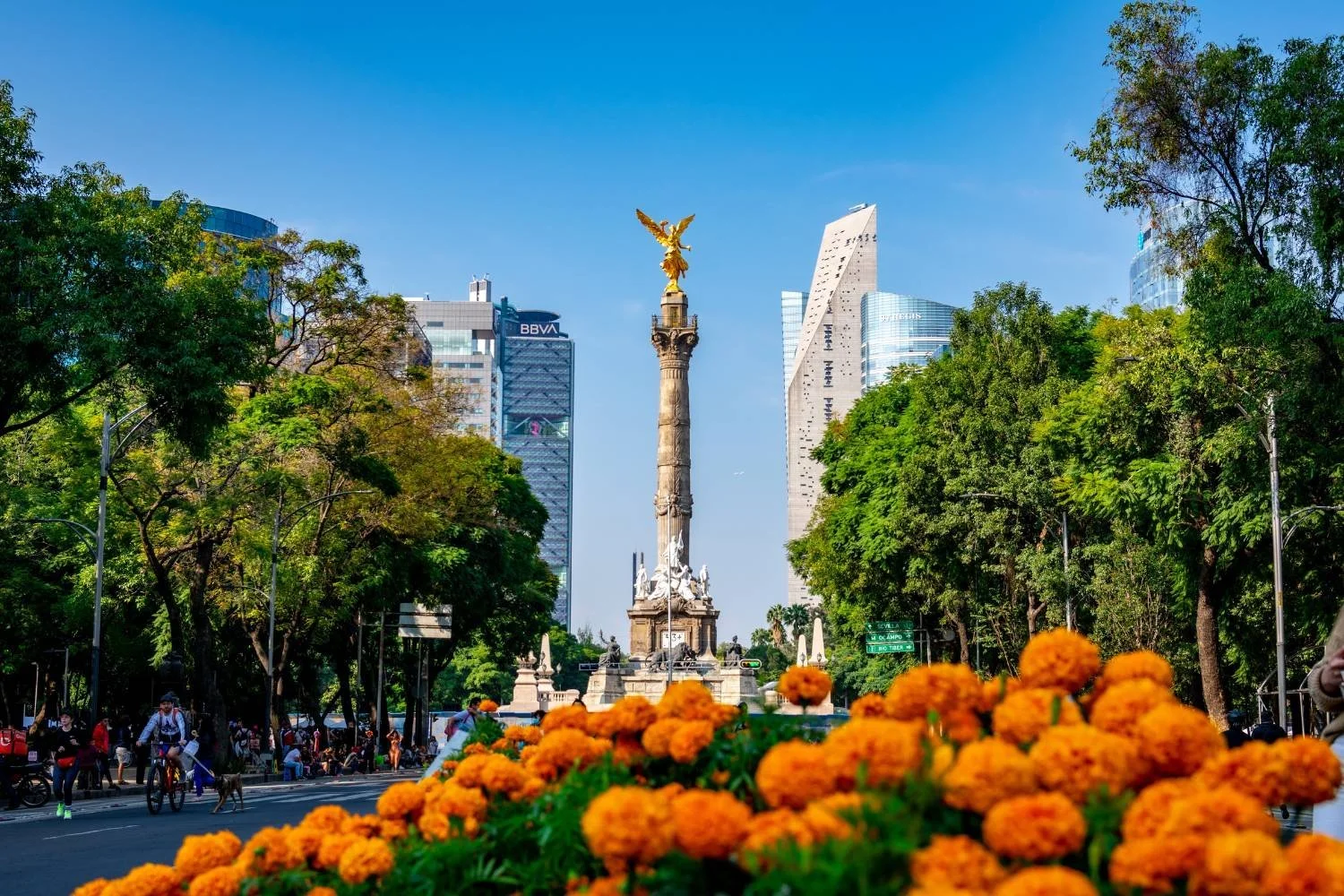
Reforma is the choice for those who want central, high-rise city living. The residential pocket along Paseo de la Reforma, the grand avenue that cuts through the heart of the city, has become a visible favourite among nomads, with modern apartment towers, amenities on the doorstep and excellent transport links in every direction. It is more vertical and metropolitan than the low-rise charm of Condesa, and it suits remote workers who want to be in the thick of the city with everything within easy reach.
Escandón sits directly beside Condesa and is the value play. It is more residential and authentically local, with noticeably lower rents than its better-known neighbour, which has made it a favourite among nomads who want Condesa's location and walkability without Condesa's prices. It is quieter and less polished, which is exactly its appeal for many.
For the wider picture across the whole city, including the family-oriented and quieter areas beyond these three, see our full guide to moving to Mexico City.
4. Internet and coworking
Reliable internet is non-negotiable for remote work, and Mexico City delivers it genuinely well in the central neighbourhoods. Connectivity here is good, and you have a real choice of providers. The three most relevant for residents are:
Totalplay runs on symmetric fibre, which means your upload speed matches your download. That matters for video calls and pushing large files to the cloud. Residential plans run from 100 Mbps through 150, 250, 350 and 500 Mbps up to 1 Gbps, with multi-gigabit plans of 5 and 10 Gbps available in well-covered urban areas. It is consistently rated the fastest fixed network in the country.
Telmex (Infinitum) runs on fibre, with plans reaching up to 1 Gbps where full fibre is installed to the address, and symmetric upload on many of its tiers. It has the widest coverage of the three, so it is often the easiest to get connected quickly.
Izzi offers plans up to 1 Gbps, though much of its network is cable rather than full fibre, which means upload speeds are typically lower than download. That is fine for general use and less ideal if you upload heavily.
For everyday remote work, video calls and streaming, a plan in the 100 to 300 Mbps range from any of these is comfortably more than enough. Most furnished rentals aimed at remote workers include a solid fixed line, and a local mobile data plan as backup is good value for the occasional outage.
The coworking scene is mature. You will find international operators alongside a strong set of independent Mexican spaces, with options ranging from hot desks by the day to private offices. Many nomads mix a coworking membership with café days, and the café-as-office culture in Condesa and Roma is genuinely accommodating rather than merely tolerated.
🏴 VIAMEXICO NOTE Internet quality is street-specific, not just neighbourhood-specific, and the best provider can differ from one block to the next. Before you commit to a longer rental, ask the landlord, or better still a neighbour, which provider they use and what speed they actually get on that street. A neighbour will give you the honest answer. If you can, run a speed test on the unit's own line. A great neighbourhood with a poor connection in your specific apartment is still a poor place to work.
5. Cost of living for a single nomad
What a single remote worker spends in Mexico City varies enormously by lifestyle, but the honest mid-range picture for 2026 looks roughly like this:
| Monthly expense | Typical cost |
|---|---|
| Rent (furnished 1-bed in Condesa, Roma or Juárez) | MXN 18,000 – 32,000 |
| Coworking (hot-desk membership) | $200 – $250 USD |
| Eating and groceries | $350 – $600 USD |
| Transport (metro and app-based rides) | Low; most central living is walkable |
| All-in monthly budget | ~$1,500 – $2,500 USD |
All in, a single nomad living comfortably but not extravagantly in a central neighbourhood might budget somewhere around US$1,500 to US$2,500 per month, with rent the main variable. We quote rents in pesos because that is how you will pay them, and budgets in dollars because that is how most of our readers earn.
MORE GUIDANCE LIKE THIS.
Practical tips on visas, neighbourhoods, healthcare, and everyday life in Mexico, straight to your inbox.
6. Banking and money
This is where your visa choice comes back to matter. On a tourist permit, opening a Mexican bank account ranges from difficult to impossible, and branch-level discretion makes the experience inconsistent. Most nomads on tourist status simply run their finances through international tools, using a multi-currency account to hold and convert money and withdrawing pesos as needed, which works perfectly well for everyday life.
Once you hold temporary residency and a residency card, a local account becomes realistic, and that opens up domestic conveniences like local direct debits and easier long-term leases. The practical sequence is to manage day to day through international banking at first, then add a Mexican account once your residency is in place.
7. Safety and practical tips
An honest word on safety, because it is the question every newcomer has. The central neighbourhoods where remote workers live are, in day-to-day terms, comfortable and walkable, and hundreds of thousands of foreigners live here without incident. The sensible approach is ordinary big-city awareness: use registered or app-based transport rather than hailing on the street, stay alert with your phone in crowded areas, and learn which specific blocks are best avoided late at night.
A few practical notes that smooth the first weeks: the dry, high-altitude climate catches people off guard, so expect cooler evenings than you might assume for Mexico; carry some cash, as smaller establishments are cash-first; and a little Spanish goes a long way socially and practically, even in a city where you can get by in English in the central areas.
8. Building a social life
The thing that turns a stay into a life is the people, and this is where Mexico City quietly excels. The remote-work and expat community is large and genuinely welcoming, organised through language exchanges, coworking events, interest-based meet-ups and a busy calendar of cultural happenings. It is one of the easier cities in the world to arrive in alone and not stay alone for long. Putting a little effort into the community early, rather than working in isolation from your apartment, is the single biggest difference between nomads who love the city and those who drift away after a couple of months. Our guide to the expat community in Mexico City maps where those networks actually meet, neighbourhood by neighbourhood, including the groups worth joining before you land.
9. How ViaMexico can help
Setting yourself up properly in a new country is a lot to coordinate alone, particularly the parts that have to happen in the right order, like sorting your legal status before you try to bank or sign a lease. ViaMexico's digital nomad relocation service handles the whole sequence for you: Residency, housing, banking, coworking space, a local number, and an orientation to the neighbourhoods so you land somewhere that genuinely fits how you work and live. We coordinate the bureaucracy through a vetted local network so you can focus on your work and on actually enjoying the city.