
THE EXPAT COMMUNITY IN MEXICO CITY: NEIGHBOURHOODS, NETWORKS, AND HOW TO SETTLE IN
Mexico City has one of the largest and most established expat communities in Latin America, and for anyone moving here, that is a genuine advantage. It means networks to plug into, events most nights of the week, services in English, and a soft landing in a city that can otherwise feel overwhelming. It also means you are far from the first person to arrive not knowing a soul.
There is an honest truth worth stating up front, though. The expats who settle best here are not the ones who find the biggest expat bubble and stay inside it. They are the ones who use the community to land softly, then build a life that reaches beyond it, into the neighbourhood, the language, and Mexican friendships. This guide covers both: where the community is and how to plug into it, and how to turn a soft landing into a life that genuinely feels like home.
1. THE SCALE OF MEXICO CITY'S EXPAT COMMUNITY
Mexico City has drawn foreigners for decades, but the last few years have changed the picture markedly. The rise of remote work, the city's balance of cost and lifestyle, and its growing reputation among digital nomads have brought a wave of new arrivals, concentrated heavily in a handful of central neighbourhoods.
The upside for a newcomer is real. A large community means you can find answers to almost any practical question within hours, meet people who arrived a year ago and remember exactly what you are going through, and reach an entire layer of English-speaking services, from doctors to lawyers to house cleaners, while you find your feet.
There is a flip side worth naming. In the most popular neighbourhoods, Roma and Condesa above all, the pace of arrival has been significant enough to reshape rents and change the character of the streets, and it has created real tension with longer-standing residents. It is not our place to lecture, but the expats who are welcomed rather than resented tend to be the ones who learn some Spanish, spend their money locally, and treat the neighbourhood as a home to join rather than a backdrop to their own scene. More on that later.
2. WHERE EXPATS PREDOMINANTLY LIVE
Expats in Mexico City cluster in a surprisingly small number of neighbourhoods, mostly in the central and western parts of the city, and they broadly sort by life stage and budget.
Younger arrivals, digital nomads, creatives and remote workers gravitate to Roma Norte, Condesa and Juárez: walkable, social, café-heavy neighbourhoods where meeting people takes little effort. Families, senior professionals and wealthier arrivals lean towards Polanco, Lomas de Chapultepec and Santa Fe: quieter, more residential, and closer to the international schools. It is a generalisation, with exceptions everywhere, but it holds often enough to be a useful starting map.
The sections below focus on the community and social character of the main expat neighbourhoods, who lives there and what it is like to plug in socially. For the practical detail on each area, the rents, the amenities and what daily life actually costs, our Mexico City destination page and our complete guide to relocating to Mexico City go deeper.
3. CONDESA AND ROMA NORTE
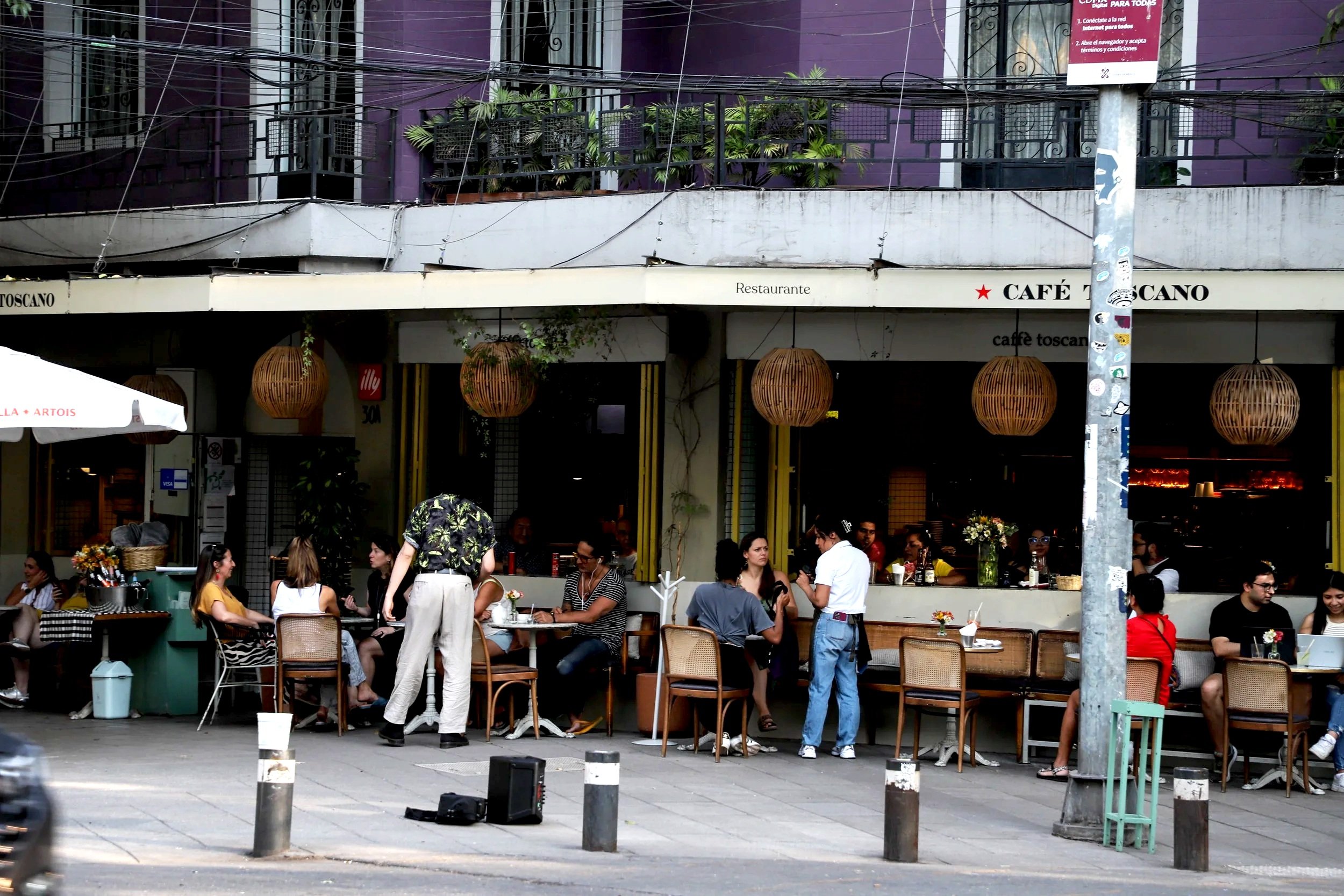
If Mexico City has an expat heartland, this is it. Roma Norte and Condesa, two adjoining neighbourhoods usually spoken of in the same breath, are where the younger international crowd concentrates, and where meeting other foreigners takes the least effort of anywhere in the city. The appeal is not hard to understand. Tree-lined streets, Art Deco architecture, two of the city's best green spaces in Parque México and Parque España, and a café and restaurant scene that rivals anywhere in Latin America. It is walkable, dog-friendly, and full of coworking spaces and laptop-friendly cafés, which is exactly why the digital nomad community has made it home. If you want to arrive and be surrounded by people in the same position within your first week, this is where you come. We cover the area in more depth in our digital nomad guide to Mexico City.
It is also, as noted, the centre of the gentrification conversation. The influx that makes it so welcoming to newcomers is the same influx that has driven rents up and unsettled longer-standing residents. None of that means you should not live here. It is just part of the context worth understanding before you do.
4. POLANCO
Polanco is Mexico City's most polished neighbourhood, and it draws a different expat entirely. This is where affluent professionals, executives on assignment and well-established families tend to land. Think Avenida Presidente Masaryk, the city's luxury shopping street, the Museo Soumaya, and a concentration of the country's finest restaurants.
The social texture is quieter and more grown-up than Roma or Condesa. You are less likely to fall into a friendship over a laptop in a café, and more likely to meet people through work, through your building, or through your children's school. It suits those who want comfort, security and polish over bohemian energy, and who are content for their social life to build gradually rather than instantly.
5. LOMAS DE CHAPULTEPEC
Lomas de Chapultepec is home to our founder, so this is a neighbourhood we know from the inside. Leafy, hilly and intensely residential, Lomas is a world away from the buzz of Condesa. Large homes sit behind gates on quiet streets, embassies dot the area, and the pace is calm and private. It is popular with established families, senior professionals and diplomats, and it sits close to several of the international schools, which is a large part of its draw for families.
The trade-off is that Lomas is not a neighbourhood where you meet people by walking out of your front door. Social life here is more private, and it tends to build through specific channels: your children's school and its parent network, a sports or golf club, your professional circle. It rewards those willing to seek connection out rather than have it handed to them on a café terrace. For families settling for the long term, that slower, deeper way of building community often suits better than the churn of a more transient neighbourhood. If schools are part of your decision, our guide to international schools in Mexico City explains how those parent networks work.
MORE GUIDANCE LIKE THIS.
Practical tips on visas, neighbourhoods, healthcare, and everyday life in Mexico, straight to your inbox.
6. ONLINE COMMUNITIES AND FACEBOOK GROUPS
Before you meet anyone in person, you will almost certainly meet them online. Mexico City's expat community lives substantially on Facebook, in a set of active groups that serve as the community's noticeboard, marketplace and helpdesk all at once. They are the fastest way to get a practical question answered, find a flat, sell your furniture when you leave, or simply see what is on this weekend.
The groups broadly fall into a few types: large general expat groups for the whole city, housing and flat-share groups, women's groups, nationality-specific groups, and interest or hobby groups. It is worth joining several, because each has its own tone and its own strengths.
A good starting set of active groups, from general to nationality-specific:
| Facebook group | Best for |
|---|---|
| Moving to Mexico | Planning and logistics, nationwide |
| Foreigners & Expats in Mexico City (CDMX) | General CDMX questions and networking |
| Foreigners in Mexico City: Activities & Events | Finding events and meetups |
| British & Irish in Mexico | UK and Irish arrivals |
| Americans in Mexico City | US arrivals |
| Canadians living in Mexico | Canadian arrivals |
🏴VIAMEXICO NOTE The Facebook groups will make you feel connected before you actually are. That is useful for landing and misleading as a measure of a social life. Use them to get set up and to find your first few contacts, then put the real effort into showing up in person. A busy notifications feed is not the same as a friend.
7. EXPAT EVENTS AND THE SOCIAL SCENE
Beyond the screen, Mexico City has an active in-person scene for meeting people, and turning up to it repeatedly is how most newcomers turn strangers into friends. The options run from structured networking to casual hobby meetups.
Language exchanges, or intercambios, are among the best entry points, because they mix expats and locals by design and give you a reason to practise your Spanish. Beyond those, there are professional networking events, coworking community nights, running and cycling clubs, sports leagues, book clubs, and regular meetups organised through the Facebook groups above and through platforms built for exactly this.
Rather than chase any single event, the practical move is to know where they are listed. Meetup and Eventbrite are where most of Mexico City's expat and language-exchange activity is posted, from weekly intercambios to networking nights and hobby groups. Searching either for "Mexico City language exchange," "CDMX expat" or "Mexico City networking" will surface whatever is running the week you arrive. Facebook, through the groups above, is the third place these get shared. Schedules and venues change often, so the current listing is always a better guide than any fixed recommendation.
The single most useful thing to know is that consistency beats novelty. One meetup you attend every week will build you a social circle far faster than ten you try once. The people who struggle socially here are rarely the ones who cannot find events. They are the ones who go once, feel it did not click immediately, and stop.
8. LEARNING SPANISH AND INTEGRATING
This is the section that matters most, and it is the one the comfortable expat bubble most tempts you to skip.
You can get by in the expat neighbourhoods of Mexico City with very little Spanish. Plenty of people do. But getting by and settling in are different things, and the gap between them is almost entirely language. Even basic Spanish transforms the daily experience, and it is the single biggest thing that gets you out of the bubble and into the actual city. Lessons are widely available, and a good tutor will move you along quickly.
There is a cultural point that sits alongside the language. Mexicans are, in our experience, genuinely welcoming to foreigners who make an effort, and that effort is met more than halfway. The expats who build the richest lives here are almost always the ones who mix locals and other foreigners, rather than staying inside a purely international circle. It opens doors that stay shut to people who never leave the enclave.
Be honest with yourself about the timeline, too. The first few months are often the hardest, and building real friendships from scratch takes more deliberate effort here than it did back home, where your networks already existed.
🏴 VIAMEXICO NOTE The first year is the hardest, for almost everyone. Building friendships from nothing takes more deliberate effort here than it did at home, and it rarely happens quickly. That is not a sign it is going wrong. It is the normal shape of it, and it comes good for those who keep pulling on the threads: work, schools, clubs, hobbies, the neighbourhood, one introduction leading to the next.
9. HOW VIAMEXICO HELPS YOU SETTLE IN
A move is not finished when the boxes are unpacked. The hardest part, for many people, is the settling in that comes afterwards, and it is the part most relocation help ignores entirely.
We think about it from the start. That begins with landing you in the right neighbourhood for your life stage, rather than the one a listicle told you was best, because where you live shapes how readily you build a life. From there we help with the practical pieces of settling in, including Spanish lessons and introductions into the networks that fit your situation, whether that is a family with school-age children or a retiree looking for community.
The goal is simple: that a few months after you arrive, Mexico City feels less like somewhere you are visiting and more like somewhere you live. If that is the kind of move you are planning, we would like to help.