
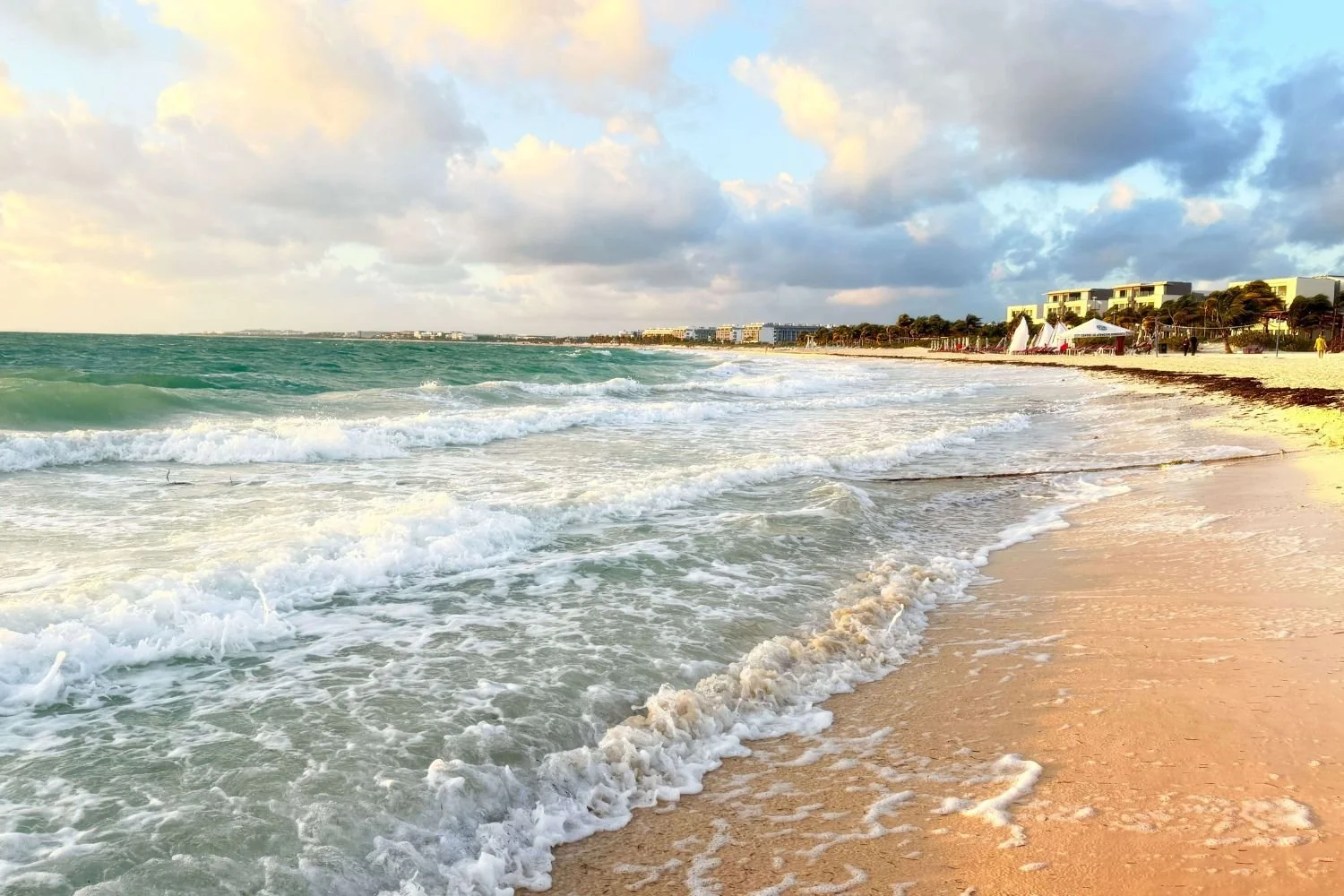
Playa del Carmen sells itself in a single glance: turquoise Caribbean water, a walkable town, and one of the largest English-speaking communities in Mexico. It is a genuinely appealing place to retire. It is also the kind of place where the glossy version and the lived reality diverge, and most guides only tell you the glossy half.
This one tells you both. Here is what retiring in Playa del Carmen actually costs, what the community and healthcare are really like, and the handful of things nobody mentions until you have already signed a lease.
1. Why Playa del Carmen attracts retirees
The pull is easy to understand. You get warm Caribbean weather year round, white-sand beaches and cenotes on your doorstep, and a town compact enough to live in without a car. Cancún airport is under an hour away, so flights home are frequent and short, which matters more than people expect when family is a plane ride away.
It is also one of the most established expat hubs in the country, so the practical scaffolding already exists: English-speaking doctors, international restaurants, coworking spaces, and neighbours who have been through the same move. For a first move abroad, that soft landing has real value.
2. The cost of living
Playa del Carmen is more expensive than inland expat cities such as Mérida or Lake Chapala, because rents are priced at tourism levels rather than local ones. It still costs meaningfully less than most of the United States, Canada or Western Europe, but go in with accurate numbers.
Rent is the biggest variable. In early 2026, a one-bedroom apartment averages around MXN 15,500 a month (roughly USD 870), with most falling between MXN 13,500 and MXN 17,500 (about USD 755 to USD 980). In popular expat zones near the beach and Fifth Avenue, furnished one and two-bedroom condos typically run MXN 15,000 to MXN 25,000 (around USD 840 to USD 1,400). In more local neighbourhoods further from the water, you can find one-bedrooms from around MXN 8,500 (about USD 475).
For a realistic monthly picture, a retired couple living comfortably in Playa del Carmen, renting a nice apartment in a good area and eating out regularly, tends to spend around USD 2,400 to USD 3,800 all in. A more modest routine, cooking at home and living slightly back from the beach, brings that down toward USD 2,000. Beachfront living with frequent dining out pushes past USD 4,500. For a fuller breakdown of what a retirement budget looks like across the country, see our guide to how much money you need to retire in Mexico.
Here is how that comfortable budget compares with the other cities retirees most often weigh up:
| City | Monthly budget (couple) | Notes |
|---|---|---|
| Puerto Vallarta | $3,060 to $5,340 | Two-bedroom rental in a good area, groceries, dining out regularly, and private health insurance. Sits mid-spectrum: more than inland smaller cities, less than Mexico City's premium neighbourhoods. |
| Lake Chapala / Ajijic | $2,000 to $3,000 | Often among the lowest monthly costs of the well-established expat destinations, thanks to lower rents and a lower overall cost of living outside a major metro area. |
| Mexico City (Polanco, Condesa, Lomas) | $3,000 to $4,500+ | The most expensive option on this list, reflecting Mexico City's status as the country's most expensive housing market, offset by unmatched access to world-class private healthcare, culture, and international connectivity. |
| Mérida | $2,000 to $3,000 | A strong middle ground, with a lower cost of living than Mexico City and a well-established, growing expat community. |
| Playa del Carmen | $2,400 to $3,800 | Similar to Puerto Vallarta, with some upward pressure from tourist-driven pricing in the most central areas. |
🏴 VIAMEXICO NOTE The single most underestimated line in a Playa budget is electricity. Air conditioning runs most of the year, the state utility bills every two months, and a heavy-use household can see USD 150 to USD 350 a month. Always ask whether a rental has its own meter and inverter air conditioning before you sign.
3. The best areas to live
Where you live shapes your daily cost and your peace and quiet more than anything else.
Playacar is the gated, upscale option: golf, security, larger homes, quiet streets, and a short drive from the centre. It suits retirees who want space and calm over walkability, and it is priced accordingly.
Centro and near Fifth Avenue puts you in the walkable heart of town, steps from restaurants and the beach. It is the most convenient and the most expensive, and also the noisiest, so choose the specific street with care.
Zazil-Ha, Gonzalo Guerrero and Coco Beach, north of the centre, are long-standing expat favourites: near the water, quieter than the core, and full of condo buildings with pools and security.
Colosio and Ejidal are the more local, lower-cost neighbourhoods. Your money goes further and daily life feels more Mexican, at the cost of walkable beach access.
| Area | Best for | Character | Relative cost |
|---|---|---|---|
| Playacar | Space, security and quiet | Gated, upscale, golf | High |
| Centro / Fifth Avenue | Walkability and convenience | Lively and central, can be noisy | High |
| Zazil-Ha, Gonzalo Guerrero, Coco Beach | Beach access with more calm | Established expat condo living | Mid to high |
| Colosio, Ejidal | Value and a more local feel | Residential and Mexican | Lower |
4. Healthcare
Private healthcare in Playa del Carmen has improved markedly in recent years. The main private hospitals, Hospiten Riviera Maya and Costamed, handle most day-to-day and emergency needs, and English-speaking doctors are straightforward to find. A private consultation typically runs USD 40 to USD 70.
For complex or specialist treatment, many residents travel the hour to Cancún, which has larger hospitals and a wider range of specialists. It is worth knowing that before you need it: excellent everyday care locally, with the bigger centres a short drive north. Getting you registered with the right hospital and an English-speaking doctor before you arrive is part of what our retiree relocation service sets up.
How you pay for that care is a separate decision, and our guide to healthcare in Mexico for expats compares private insurance against voluntary IMSS enrolment, including who IMSS will turn down.
5. The expat community
This is one of Playa del Carmen's genuine strengths. The town is home to an estimated 15,000 to 25,000 foreign residents, somewhere around 10 to 15 percent of the population. Americans and Canadians make up the largest groups, followed by Argentines, Colombians, Spanish, Italians and other Europeans.
In practice that means an active, visible community: social groups, events, volunteering, and a steady supply of people who moved recently and remember how it felt. Building a social life here is quicker than in most Mexican cities, which is a real comfort in the early months.
MORE GUIDANCE LIKE THIS.
Practical tips on visas, neighbourhoods, healthcare, and everyday life in Mexico, straight to your inbox.
6. Safety: An honest assessment
Day-to-day life in Playa del Carmen is safe, and the vast majority of retirees go about their routines without incident. The honest caveat is that Quintana Roo has seen occasional violence connected to the drug trade, usually tied to the nightlife scene rather than residential expat life, and it very rarely touches the daily experience of retirees.
The practical risks that actually affect residents are ordinary ones: petty theft and opportunistic scams. Sensible precautions, the same you would take in any tourist town, cover most of it. It is neither the paradise some sites pretend nor the danger others imply. It is a normal, busy Caribbean town.
7. Visas and residency
To retire in Playa del Carmen properly, you will want temporary or permanent residency rather than living on tourist permits. Both are granted mainly on financial grounds, income or savings, and the application starts at a Mexican consulate in your home country before you move.
The thresholds change each year and vary by consulate, so the figures are worth confirming for your specific case. Our full guide to temporary residency in Mexico walks through the routes, and if you intend to stay for good, our permanent residency guide covers the direct and four-year paths. This article also sits alongside our wider guide to retiring in Mexico.
8. The downsides nobody mentions
Here is the part most guides skip.
Sargassum season. From roughly spring into late summer, brown sargassum seaweed washes onto the Caribbean beaches, sometimes in large quantities, with a smell to match. Crews clear the main beaches, but it is the single biggest gap between the postcard and the reality. If pristine beach every day is the dream, visit in May or June before you commit.
Heat and humidity. It is hot and humid for much of the year. You acclimatise, but the air conditioning, and its bills, are not optional.
High-season noise and crowds. From November to April the town fills with tourists, and Fifth Avenue nightlife carries. A central address is convenient in the day and loud at night.
A transient community. Playa's expat scene is more seasonal than most. A large share are snowbirds who come for the high season, roughly November to April, and head home for the summer. The upside is a steady stream of new faces. The trade-off is that some of the friendships you form will be seasonal, which takes a little getting used to.
Hurricane season. June to November brings the risk. Direct hits are uncommon and buildings are built for it, but it is part of Caribbean life.
🏴 VIAMEXICO NOTE None of these are reasons not to retire in Playa del Carmen. They are reasons to arrive informed, choose the right neighbourhood and building, and time your first visit well. The retirees who are happiest here are the ones who knew all of this before they came.
9. How ViaMexico can help
Retiring in Playa del Carmen is very doable. It is also a lot of moving parts: the right residency route, a lease that does not catch you out on electricity or short-term pricing, healthcare set up before you need it, and a neighbourhood matched to how you actually want to live.
That is what we handle. Our relocation service for retirees coordinates the whole move through a single point of contact and a local team on the ground, so you arrive to a life that is ready rather than a to-do list. We have lived this move ourselves, and we will tell you the honest version of any city, including the parts in section eight.