
Learning Spanish in Mexico: schools, tutors and what actually works
How much Spanish you need to move to Mexico, and how people who live here actually learn it: language schools, university courses, private tutors, intercambios and learning as a family. With published prices and a realistic timeline measured in hours.
In this guide:
1. How much Spanish you need before you arrive
Do you need to speak Spanish to live in Mexico? Not to complete the move, but yes to live here independently. Our guide to moving to Mexico from the US names the language as the biggest early friction.
What you can manage without Spanish
The move itself, expat neighbourhoods of large cities, and professionals who serve foreigners. You do not need Spanish to get through the move itself.
Where English runs out
Government offices, INM counters, notaries, utilities, plumbers, pharmacies away from the centre, medical appointments in smaller cities, and the neighbour telling you about tomorrow's water cut. Outside the large private hospitals, much of what our guide to healthcare in Mexico for expats describes happens in Spanish.
A sensible target before you land
Aim to arrive at roughly A1 to A2 on the Council of Europe's CEFR global scale, which describes an A2 speaker as able to "communicate in simple and routine tasks requiring a simple and direct exchange of information". In practice: greetings, prices, directions, polite requests and the usted form.
If you plan to stay for good
Naturalisation includes a Spanish exam, with no exemption for age; the FAQ below has the detail.
VIAMEXICO NOTE: In the first month, most clients we work with need Spanish for the same few things: explaining a fault to a plumber or building manager, describing symptoms at a pharmacy, and following a phone call about a delivery. None of it needs grammar beyond the present tense, but all of it needs confidence with numbers, times and the words for things around the home.
2. Mexican Spanish and Spain Spanish: what is different
Is Mexican Spanish different from Spain Spanish? It is the same language and fully mutually intelligible, with differences in accent, some everyday vocabulary and forms of address. Mexico has its own language academy, the Academia Mexicana de la Lengua.
Pronunciation and grammar
There is no "th" sound for c and z, so gracias is said with an s. Ustedes is the plural "you" in every context; vosotros is not used.
Vocabulary you will hear every day
The Diccionario de americanismos records the Mexican meanings of words such as ahorita and camión.
¿Mande? The polite "pardon?".
Ahorita. Literally "right now"; in practice, anything from this minute to some time later.
Camión. A bus, as well as a lorry.
Platicar. To chat.
Diminutives. Un cafecito, un momentito: friendlier, not smaller.
Politeness and usted
Service encounters lean formal. Use usted with officials, older people, shop staff and anyone you have just met, and wait to be invited to tú.
School or Spain-based Spanish transfers; add a teacher who uses Mexican Spanish and plenty of listening.
3. Spanish schools in Mexico: the immersion route
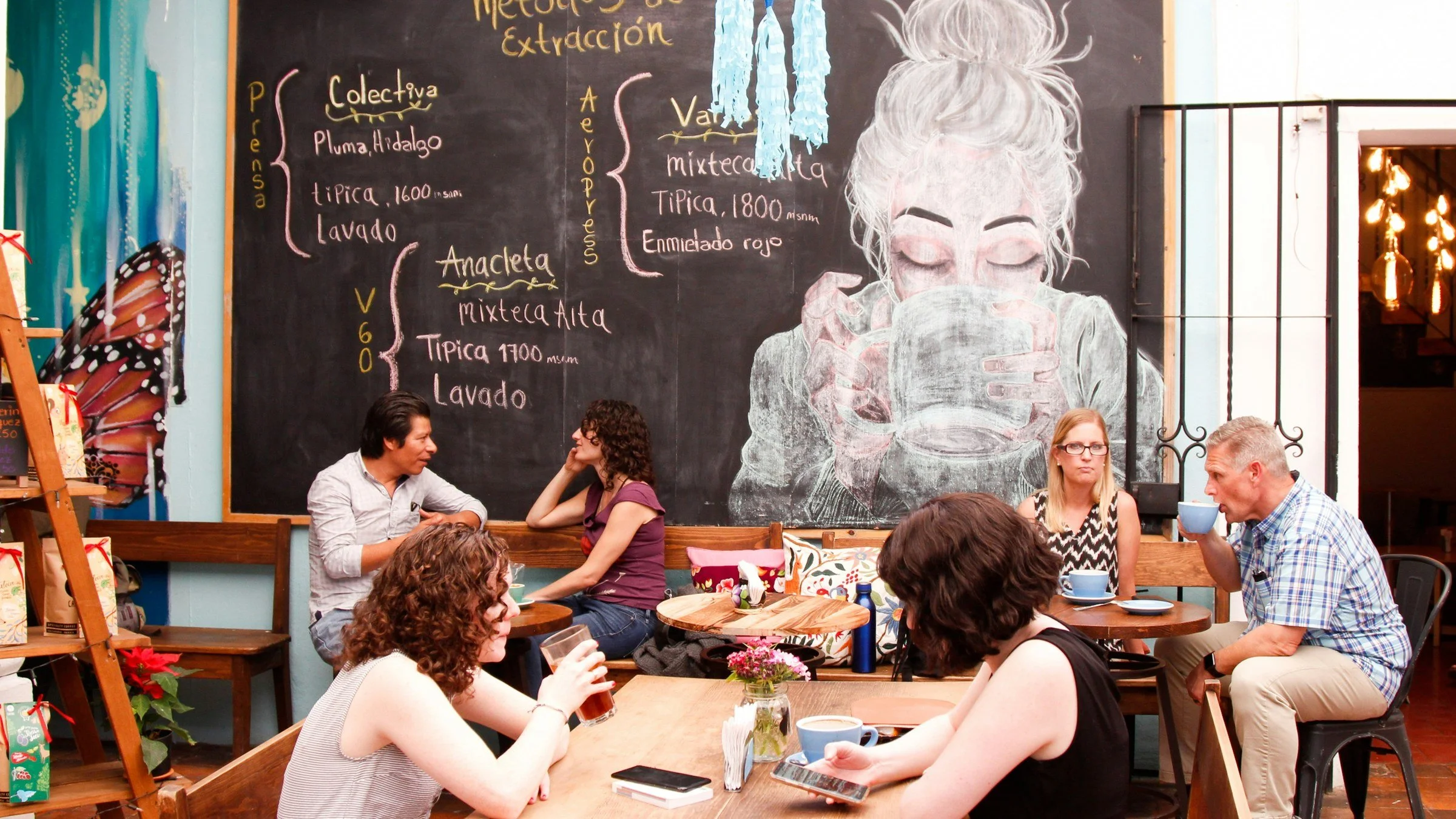
Spanish schools in Mexico give you structure: a level test, a small group and several hours of class a day. They suit people with a few free weeks, especially just after arrival. Weighing up the capital? Start with living in Mexico City.
What a week at a language school looks like
You sit a placement test, join a small group at your level and start on a Monday. Walk Spanish in Mexico City and Instituto Cultural Oaxaca both publish 20-hour weekly group programmes; the Oaxaca school's is 15 hours of class plus 5 of conversation, in groups of two to eight.
University programmes
UNAM's Centro de Enseñanza para Extranjeros (CEPE) is the public-university route. The UNAM CEPE Spanish course page lists the intensive face-to-face course at USD 727 (MXN 12,400) for basic levels (90 hours) and USD 630 (MXN 10,750) for intermediate and advanced (78 hours), about USD 8 (MXN 138) per class hour, including a coupon for a SIELE reading and listening test. CEPE Polanco's 2026 calendar lists online courses at USD 606 (MXN 10,330).
What group courses cost
Group Spanish classes in Mexico at a private school cost USD 140 to 250 (MXN 2,388 to 4,265) a week for 20 hours, on two schools' published prices checked on 28 September 2026.
Walk Spanish lists USD 140 (MXN 2,388) a week. Instituto Cultural Oaxaca's booking page lists USD 250 (MXN 4,265) for one 20-hour week, checked on 28 September 2026, with lower weekly rates for longer bookings. The school's fees page is still headed 2025, so confirm the price when you book. Conversions throughout use 17.06 MXN per USD as of 19 August 2026.
Where schools cluster
Spanish schools in Mexico City offer the widest choice. Oaxaca, Guanajuato, Cuernavaca, Mérida, San Miguel de Allende, Guadalajara, Puebla and Playa del Carmen also have language schools, though San Miguel's large English-speaking community cuts both ways for practice.
Where you live matters more than which school you pick; see our guide to the best cities in Mexico for expats.
Adults, older learners and homestays
Many schools run adult groups; ask whether yours could be mixed with teenagers on a summer course. Spanish immersion programmes for adults in Mexico often offer a homestay: constant listening practice, but also a family's meals, hours and noise. On the coast, see retiring in Puerto Vallarta.
Twenty class hours a week, plus homework, is a block of time to weigh against residency appointments, a house search and a bank account in the first months, all set out in our guide to moving to Mexico City.
4. Private Spanish tutors and what they cost
A private tutor lets you set the pace, the topics and the timetable, and lessons can come to you. Learn Spanish in Mexico City, for example, teaches at its schools, at students' homes or offices, in cafés and online.
What tutors charge
Private Spanish lessons in Mexico cost from about USD 22.50 to 29 (MXN 384 to 500) an hour on two schools' published rates checked on 28 September 2026.
Learn Spanish in Mexico City states that private lessons start at MXN 500, which is USD 29, an hour. Instituto Cultural Oaxaca sells 10 hours of private classes for USD 225, from USD 22.50 (MXN 384) an hour on that package. Independent tutors set their own rates, so treat this as a reference point, not the going rate.
Tuition is one line in a household budget; for the rest, see what living in Mexico costs.
How to choose a tutor
Ask for a trial or diagnostic lesson before buying a package. Learn Spanish in Mexico City, for one, offers a diagnostic conversation first.
Check qualifications, such as UNAM certification or training in teaching Spanish as a foreign language (ELE).
Ask for a plan tied to your real tasks: a medical appointment, a call to the landlord.
Expect homework and a way of tracking progress.
Online lessons and apps
Online lessons are the practical way to reach the A1 to A2 target in section 1 before you fly, with a live teacher rather than a screen alone. The same providers teach remotely: Learn Spanish in Mexico City offers online private lessons, and CEPE runs its online courses on the same level system as its classroom ones.
Vocabulary apps build a daily habit and fill gaps between lessons. They will not train your ear for fast speech, so keep them for review and give your real hours to a teacher and to conversation.
| Route | What you get | Published cost |
|---|---|---|
| Private language school, group course | 20 hours of small-group class a week, placement test, Monday starts | USD 140 to 250 (MXN 2,388 to 4,265) a week |
| University course (UNAM CEPE Polanco) | Fixed terms by level; 90 hours (basic) or 78 hours (intermediate and advanced) | USD 727 (MXN 12,400) basic or USD 630 (MXN 10,750) intermediate and advanced, face to face; USD 606 (MXN 10,330) online |
| Private tutor | One-to-one, your timetable, your topics | From USD 22.50 (MXN 384) an hour on a 10-hour package; from USD 29 (MXN 500) an hour |
| Apps and online platforms | Vocabulary, daily habit, lessons from home | Varies by provider; not tabled |
| Intercambio | Conversation practice, half Spanish and half English | Usually free |
Prices change and tutors set their own rates, so use the table to frame questions, not as a quote.
5. Intercambios and conversation practice
An intercambio is a language exchange: half Spanish, half English, usually free, and a good way to build listening and confidence. Mexico City's remote workers organise partly around them, as our digital nomad guide to Mexico City notes.
How to find one
Meetup, Eventbrite, school-run exchanges and community centres. Our guide to the expat community in Mexico City covers where these are listed.
Practice that does not feel like study
Take a class taught in Spanish, leave Spanish-language radio on, and ask the market stallholder how to cook what you are buying. For months you will understand far more than you can say; that is the listening doing its work.
VIAMEXICO NOTE: The English-speaking bubble is comfortable, and it is the biggest brake on progress we see. Pick one thing each week that you can only do in Spanish, and keep it. For one client, the Spanish-only thing was a weekly cooking class. The vocabulary was narrow, but it was used every week, and the confidence carried over to the market and the shops.
6. Learning as a family: children and adults
A family move needs a Spanish plan for children and adults: the school shapes a child's Spanish, while parents have to build their own.
Children
Language of instruction varies more than families expect. Some schools teach fully in English, some are bilingual, and national-system schools teach largely in Spanish; a child arriving with no Spanish may face a bridging requirement at bilingual or national-system schools, as our guide to international schools in Mexico City explains. In an English-only school, Spanish has to be added outside school.
Parents
The parent at home more often needs Spanish sooner: school messages, doctors' receptions, domestic staff. Family tutoring at home keeps everyone moving at once.
On age, a large 2018 study of people learning English found that those who start in childhood are the most likely to reach native-like grammar, with the advantage fading in the late teens. It did not measure whether adults can hold a useful conversation, which is the goal for most people moving here.
7. How long it takes to learn Spanish in Mexico: a realistic timeline
How long does it take to learn Spanish in Mexico? Measure it in hours, not months. The US State Department's Foreign Service Institute language training page puts Spanish at 24 to 30 weeks (Category I: 552 to 690 class hours) for its students to reach an integrated score of 3 in speaking and listening on the Interagency Language Roundtable scale, roughly professional working proficiency. A typical week is 23 class hours plus 17 of self-study.
What those hours mean at a resident's pace
An illustration, not a promise: FSI students study full time. At three hours of lessons a week, a resident would need about 230 weeks, over four years, to log the same 690 class hours; at six hours a week, about 115 weeks. Everyday conversation comes well before that, and practice outside class shortens the road.
Most clients we work with start keen and settle into a lighter rhythm once work, school and home take over. The ones who keep improving are those who protect a fixed weekly lesson and treat it like any other appointment, rather than fitting Spanish in when there is time.
Milestones you will notice
Shops, markets and transport without rehearsing first.
Making an appointment by phone.
Following a group conversation at dinner.
Reading a lease and knowing which clauses to query.
Where to start this month
Set a CEFR target for the next six months, such as A2 or B1.
Book a placement test or a diagnostic lesson.
Choose one structured route (school, university or tutor) and one conversation route (an intercambio or an activity in Spanish).
Put both in the diary every week.
Whether you are retiring here or moving with children, our relocation services include an introduction to a Spanish teacher we trust, with the first lesson on us.
8. Frequently asked questions
-
The Ley de Migración caps a visitor stay at 180 days, with no paid work (article 52), and the immigration officer at entry decides how many of those days you actually get. Mexico's visa rules list courses of up to 180 days at an institution in the national education system as a purpose for a visitor stay; check with the Instituto Nacional de Migración or a consulate before booking anything longer, which may call for student residency.
If you are moving here anyway, residency removes the question. Our guide to temporary residency in Mexico explains the main routes and what each asks for.
-
Yes. The Reglamento de la Ley de Nacionalidad (article 15) requires every applicant to prove they speak Spanish; refugees, minors and people over 60 skip only the history and culture test. According to the SRE nationality and naturalisation page, the Spanish exam is a short interview, a reading comprehension and a written section worth 6 points in total; you need at least 5 plus a satisfactory interview, it lasts up to 10 minutes, and you have two attempts.
Citizenship comes after years of residency; our guide to Mexican permanent residency covers that stage.
-
No. Adults often make quick early progress; what fades with age is the chance of sounding native, not the ability to learn. Favour a real teacher and real tasks, and judge progress by what you can do, not how you sound. Our guide to retiring in Mexico puts it plainly: learning the basics early pays back many times over.
-
Only if you need a certificate for work or study, or want one as a milestone. DELE diplomas are official certificates awarded by the Instituto Cervantes on behalf of Spain's education ministry, at every CEFR level from A1 to C2, per the Instituto Cervantes DELE page.
SIELE is a separate, modular test. The SRE naturalisation exam is different again: the SRE runs it itself.
9. What we arrange for clients
Finding the right teacher is where most newcomers lose time. Section 4 shows how wide the market is, and working through trial lessons until one fits can take weeks, just when motivation is at its highest.
We shorten that search. For all of our clients, we make an introduction to a Spanish teacher we trust and pay for the first lesson. If the fit is right, you carry on with the teacher directly, at your own pace and on your own schedule.
The schools, courses, tutors and intercambios in sections 3 to 5 all exist, but you do not have to sort them out alone. If you would rather study at a language school, we can find the right one and arrange your place. If a private teacher suits you better, we will introduce one we trust and pay for your first lesson. Tell us on our first call that Spanish matters to you, and we will build it into your first weeks here.
Related guides
SOURCES
Sources already linked in the body are listed without a second link (no repeated URLs on the page). All accessed 28 September 2026.
US Department of State, National Foreign Affairs Training Center, Foreign Language Training (FSI timelines). Linked in section 7.
Council of Europe, CEFR Table 1: common reference levels, global scale. Linked in section 1.
Secretaría de Relaciones Exteriores, Nacionalidad y naturalización (Spanish and history exams), https://sre.gob.mx/tramites-y-servicios/nacionalidad-y-naturalizacion, accessed 28 September 2026 (browser-verified). Linked in the FAQ.
Cámara de Diputados, Reglamento de la Ley de Nacionalidad, última reforma DOF 25-11-2013, artículo 15 (Spanish required of every applicant; over-60s exempt only from history and culture).
Cámara de Diputados, Ley de Migración, última reforma DOF 15-01-2026, artículo 52 (visitor stay of no more than 180 days, no paid work).
Secretaría de Gobernación and Secretaría de Relaciones Exteriores, Lineamientos generales para la expedición de visas, DOF 25 July 2025 (visitor stay set at entry, no more than 180 days; studies of up to 180 days as a visitor purpose).
Instituto Nacional de Migración. Linked in the FAQ.
UNAM CEPE, Español Intensivo CEPE-Polanco PPI003 course page. Linked in section 3.
Instituto Cultural Oaxaca, Plans and pricing (booking page). Linked in section 3.
Instituto Cultural Oaxaca, Fees and payment (still headed 2025)
Instituto Cultural Oaxaca, Private Spanish classes (10 hours USD 225)
Instituto Cultural Oaxaca, Spanish language programmes (Monday starts, placement test)
Learn Spanish in Mexico City, pricing, locations and diagnostic lesson FAQ. Linked in section 4.
Instituto Cervantes, Qué son los DELE. Linked in the FAQ.
SIELE, Servicio Internacional de Evaluación de la Lengua Española
Asociación de Academias de la Lengua Española, Diccionario de americanismos. Linked in section 2.
Hartshorne, Tenenbaum and Pinker, "A critical period for second language acquisition: Evidence from 2/3 million English speakers", Cognition, 2018. Linked in section 6.
Exchange rate: 17.06 MXN per USD as of September 2026 (ViaMexico working rate for articles).